
Specialist Curricula, Part Two
The provisions of this §83.120 adopted to be effective March 1, 2006, 31 TexReg 1280; amended to be effective August 1, 2006, 31 TexReg 5952; amended to be effective October 11, 2007, 32 TexReg 7050; amended to be effective February 17, 2012, 37 TexReg 681; amended to be effective January 1, 2014, 38 TexReg 9520; amended to be effective July 1, 2014, 39 TexReg 4650; amended to be effective January 1, 2016, 40 TexReg 8759; amended to be effective March 15, 2020, 45 TexReg 1693; amended to be effective January 1, 2023, 47 TexReg 8640 (Note: This section and §82.120 provide the curriculum standards that are effective before August 1, 2023. Section 83.202 provides the curriculum standards that are effective on or after August 1, 2023, which will be updated on this course before August 1, 2023.)
Technical Requirements–Curriculum Standards (up to August 1, 2023)
Specialist Curricula:

Eyelash Extension Curriculum Standards (320 Clock Hours Or Equivalent Credit Hours)
- (A) Orientation, rules and law 10 hours
- (B) First aid and adverse reactions 15 hours
- (C) Sanitation and contagious diseases 20 hours
- (D) Safety and client protection 10 hours
- (E) Eyelash growth cycles and selection 20 hours
- (F) Chemistry of products 5 hours
- (G) Supplies, materials and related equipment 10 hours
- (H) Eyelash extension application 190 hours
- (I) Eyelash extension isolation and separation 15 hours
- (J) Eye shapes 15 hours
- (K) Professional image/salon management 10 hours

Hair Weaving Curriculum Standards (300 Clock Hours Or Equivalent Credit Hours)
- (A) Hair weaving:
Basic hair weaving, repair on hair weaving, removal of weft, sizing and finishing by hand of hair ends or by using mechanical equipment 150 hours - (B) Shampooing client, weft and extensions:
Basic shampooing, basic conditioners, semi-permanent and weakly rinses, basic hair drying, draping 50 hours - (C) Professional practices:
Hair weaving as a profession, vocabulary, ethics, salon procedures, hygiene, grooming, professional attitudes, salesmanship, public relations, hair weaving/braiding skills, including purpose, effect, equipment, implements, supplies, and preparation 40 hours - (D) Anatomy and physiology-scalp:
Major bones and functions, major muscles and functions, major nerves and functions, skin structures, functions, appendages, conditions and lesions, hair or fiber used, structure, composition, hair regularities, hair and scalp diseases 30 hours - (E) Chemistry in hair weaving:
Elements, compounds, and mixtures, composition and uses of cosmetics in hair weaving 10 hours - (F) Sanitation and safety measures:
Definitions, importance, sanitary rules and laws, sterilization methods of unused hair and fiber droppings 10 hours - (G) safety measures:
Client protection 10 hours
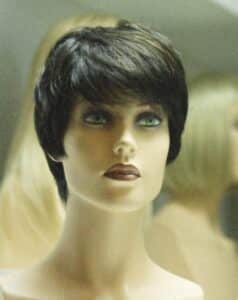
Wig Curriculum Standards (300 Clock Hours Or Equivalent Credit Hours)
- (A) Combing out 50 hours
- (B) Styling 50 hours
- (C) Coloring, tinting, bleaching 37 hours
- (D) Rolling 30 hours
- (E) Cutting and shaping, scissors and razor 20 hours
- (F) Hot iron 19 hours
- (G) Cleaning 10 hours
- (H) Alterations, installation of elastic 10 hors
- (I) Conditioning 10 hours
- (J) Brushing technique prior to styling 10 hours
- (K) Identification and recognition definition-wigs, wiggery, wigology-pertaining to any human, synthetic, or animal hairpiece 10 hours
- (L) Sanitation, disinfecting, required rules and laws 10 hours
- (M) Eye tabbing 10 hours
- (N) Sizing 5 hours
- (O) Drying 5 hours
- (P) Measuring head for proper size 5 hours
- (Q) Preparation of wig on block 5 hours
- (R) history, background, and salesmanship 3 hours
- (S) Knowledge of coloring: J L 1 hour